CCP-volumeEM OME-NGFF Hackathon
11 - 12 March 2026
Hinxton, UK
Event Overview
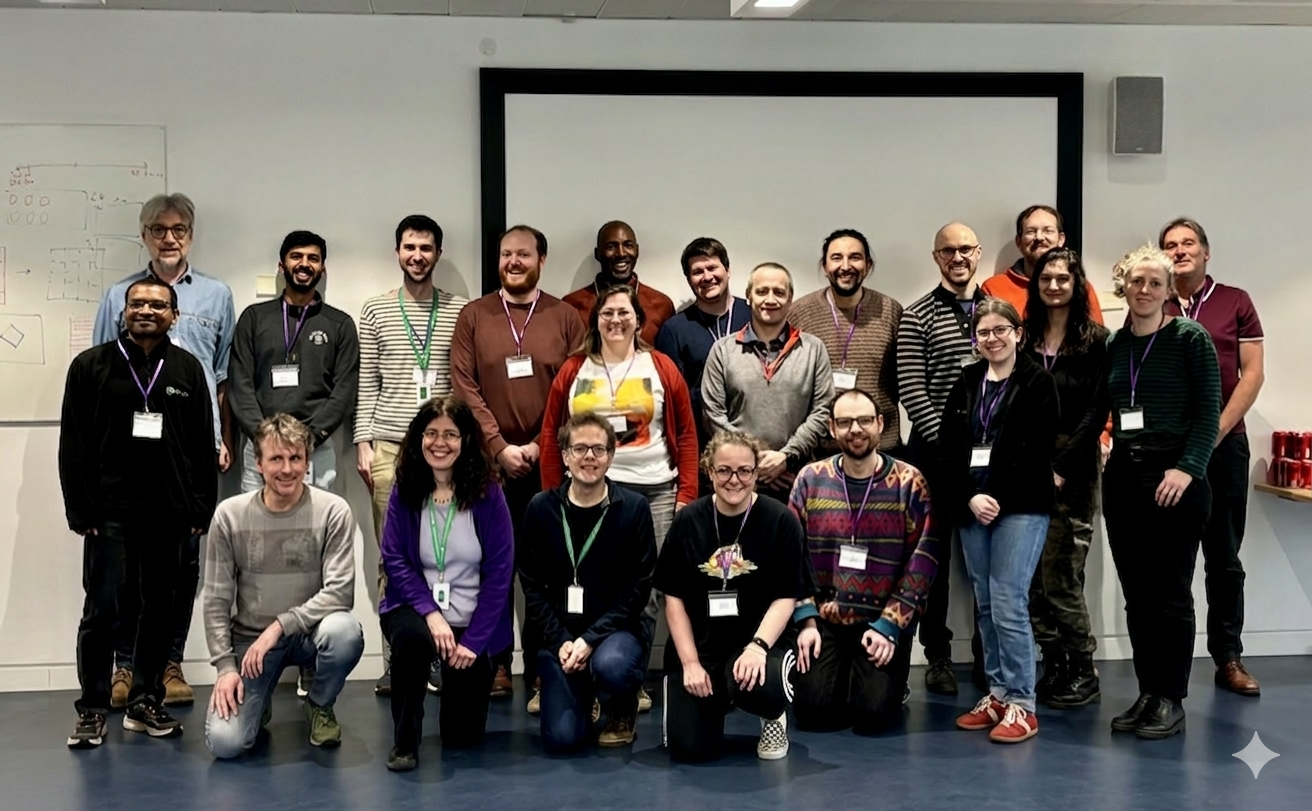
The CCP-volumeEM OME-NGFF Hackathon was organised by the EMPIAR team at EMBL-EBI and took place in person from 11–13 March 2026 in Hinxton, UK. The event was funded by UKRI through CoSeC.
Over two and a half days, 23 particpants came together to work on a range of topics focused on the OME-Zarr file format and its use within the volume electron microscopy community.
Hackathon outputs
1. An image.sc Zulip communication channel was created to support discussion between participants: CCP-volumeEM-OME-NGFF-Hackathon
2. Public repositories were created on the CCP-volumeEM GitHub space:
Ome-zarr conversion: https://github.com/ccp-volume-em/omexml_notebooks
Ome-zarr storage of unstitched tiles: https://github.com/ccp-volume-em/unstitched-tiles-storage
3. A napari plugin was created to load ome-zarr files with coordinate system selection, and has been published here: https://github.com/ome-zarr-models/ome-zarrpari
4. Other notable outputs:
Outputs from the first team were recorded in a HackMD: https://hackmd.io/@sAlXJb_1SeyxWsQoc_CWQw/Syyougy5We
A vendor use case was discussed including in a image.sc thread: https://forum.image.sc/t/separate-tiles-to-ome-zarr/109071
Interview with hackathon attendee Lucy Isherwood
Tell us a bit about your (scientific) self
I work across two core imaging facility’s, Light Microscopy and Electron Microscopy, outside of the day-to-day running of the facilities, I’m especially interested in pushing forward the development of Volume Correlative Light and Electron Microscopy (vCLEM). This involves handling complex and very large imaging datasets.
Why did you get involved in the hackathon?
Previously, most of my experience was focused on generating images rather than analysing them. However, image analysis is increasingly becoming a major bottleneck, particularly with volume EM and large-scale imaging datasets.
I had already started exploring different programmes, plugins, and file formats, but the field can feel quite confusing, overwhelming, and rapidly changing. The hackathon felt like a great opportunity to better understand the landscape, see things from a different perspective, and learn more about how developers and computational scientists approach these challenges.
What were you hoping for?
Mainly, I wanted to learn more about how these systems and workflows are developed behind the scenes. As an end-user, you often work with tools without fully appreciating how much thought, collaboration, and development goes into making them usable, scalable, and accessible.
Not coming from a programming background, running code can still sometimes feel a bit like performing a magic trick, you can see the result, but not always what is happening underneath. I was hoping the hackathon would help make some of that feel more approachable and understandable.
I also wanted to gain insight into how the community is tackling the challenges of increasingly large and complex imaging datasets, and to come away with ideas that might help shape future workflows and approaches in our own work.
What did you bring to the table?
I mainly brought the perspective of someone generating imaging data and workflows on a day-to-day basis in a core research facility. While I don’t come from a development background, I could contribute practical experience around how tools are used in real experiments, the challenges users face, and the realities of working with large datasets in imaging facilities.
Were there any difficulties or challenges?
One of the biggest challenges for me was understanding exactly what developers were looking for and what information would be most useful to them. At times I felt like I was gaining a lot from conversations, but I wasn’t always sure how much I was contributing back.
I think there can sometimes be a communication gap between non-programming users and software developers. While I don’t think I yet have the knowledge or experience to bridge that gap myself, the hackathon made me realise there is real value in people from both worlds sitting together. Those who understand the practical needs of experimental work and also have enough familiarity with computational approaches to help connect the two perspectives.
What was the most surprising thing?
Probably the most surprising thing was how positive and collaborative the whole atmosphere was. Everyone had a very open and proactive attitude towards improving things, it’s how you would want all meetings to be run.
It also made me aware of aspects I hadn’t really thought about before, such as the importance of support, funding, and recognition for open-source and open-access software development. The hackathon really opened my eyes to how important those factors are in enabling this kind of work.
What was the best thing about the experience?
There were a few really positive outcomes from the experience. I was able to get help with some immediate issues I had been having with a dataset, and I also came away with ideas for future development, including programmes and plugins that could help address other challenges. I’ve already started using what I learned about “user stories” in development discussions to improve how our facility feeds back and reports issues to software developers.
But for me, the absolute highlight was the people and the atmosphere. Everyone was enthusiastic, supportive, and genuinely interested in making things better and more accessible for the wider imaging community. That kind of positive, collaborative environment really stays with you afterwards. It was very motivating and gave me a clearer sense of where my own knowledge is now, and where I would like it to develop in the future.
What advice would you give to someone considering attending an event like this in the future?
I would definitely say, go for it! It’s a rare opportunity to see behind the scenes of programming and understand how things come together. You learn a huge amount simply from being in the room with people approaching problems from different perspectives, and it really helps make the whole field feel more open and approachable.
Interview with hackathon attendee Joel Lüthi
Tell us a bit about your (scientific) self
I work as Head of Research and Development at the BioVisionCenter at the University of Zurich. We develop the Fractal framework for FAIR image analysis with OME-Zarrs. As such, I often get to deal with large bioimage datasets and the challenges in their analysis.
Why did you get involved in the hackathon?
While I work with many large datasets, I haven't had the opportunity to interact with volume EM data a lot so far. Developing tools for OME-Zarr image processing and being involved in the OME-Zarr specification process, it's always useful to broaden the horizon and understand the differences between modalities and their needs towards the format and the analysis software.
What were you hoping for?
This hackathon was a great opportunity to get to know people in the volume EM community, get to understand volume EM data better and learn more about the challenges people typically face. My aim was to get to know both people that acquire volume EM data, as well as people processing volume EM data. From the people that generate the data, I was hoping to learn more about the challenges of handling the growing data sizes and about the uniqueness of the different acquisition approaches. From other tool developers, my goal was to understand how they approach the image analysis, to see what tools are actively used for volume EM analysis and to figure out what can be shared between imaging modalities on the analysis side, now that we’re moving to standardized formats.
What did you bring to the table?
While it has been years that I’ve last sat in front of an electron microscope and I had never acquired my own volume EM data, I brought experience with the OME-Zarr format, knowledge about how it is developed and where people can provide feedback and knowhow in building image analysis tools around OME-Zarrs.
Were there any difficulties or challenges?
A key challenge I find at many hackathons is how limited the time is. It’s key to take the time to talk with people and understand the different perspectives and appreciate the priorities that they shape. But once a shared language is found and excitement starts for how things can be put into action, hackathons are often almost over again. It’s great to get the conversation started and align on approaches, but finding the time to follow up on all the ideas later is often hard.
What was the most surprising thing?
I was amazed to learn about all the automation and complexity solved on the acquisition side that enable the generation of terabytes of volume EM data. The naïve perspective inspired by just getting beautiful Volume EM images as complete units hides the complexity involved in their creation. Learning about how acquisitions are optimized for speed or how correlative approaches are set up gives a whole new appreciation for the resulting data.
Another surprising realization that shouldn’t actually be a surprise is how many challenges are shared across different modalities for image analysis. In Volume EM, like in many other image analysis modalities, challenges around finding sustainable models to maintain software are key and were a focus of multiple discussions. And from the user perspective, the need for easy to understand interfaces and the struggle of when to use a commercial tool and when to try the, potentially complex, open source software, is something we see shared across many modalities.
What was the best thing about the experience?
A key highlight was seeing a lot of super beautiful volume EM data, hosted publicly at the Bioimage Archive and thus easily accessible to us. It really made me appreciate both the size but also the beauty of volume EM data. And having it easily accessible to all of us during the hackathon made it so much easier to just try things out across different viewers or in different analysis tools.
What was also great was having in-depth discussions with people with very different expertise. This helped to build a shared understanding of how volume EM data gets generated, what its unique requirements are and how they relate to the specification in OME-Zarr. I was particularly happy that Thera Pals and Robert Wassens wrote up a new user story based on these discussions for the currently discussed OME-Zarr collection specification proposal (https://github.com/ome/ngff/pull/343#issuecomment-4054132101). Enabling different communities to contribute to how the specification evolves is a key success factor enabled by such hackathons.
What advice would you give to someone considering attending an event like this in the future?
Jump on in! It’s so much easier to broaden your horizon by talking to people that aren’t sitting in your office. Don’t expect to get everything done in 2 days, but see such hackathons as a starting point to learn more, prototype and get things started. And the clearer of an idea you have of what problems you want to solve and what new perspectives you want to get to know at a hackathon, the more you will take from it.